
We’ve had some unforgettable wildlife encounters in America’s national parks. Spotting moose in Denali, black bears in the Smokies, and bison in the Badlands delivered some of our biggest thrills. But sometimes, the parks surprise you. While the fauna often get the headlines, it’s the flora that has taken our breath and left an equally lasting impression.
Disclosure: This post may contain affiliate links. If you make a purchase through one of these links, I may earn a small commission at no additional cost to you. Thanks for supporting Miles with McConkey.
From towering redwoods to desert blooms, the must-see plants in national parks offer a quieter kind of wonder—one rooted in resilience, beauty, and place. These iconic trees and rare plants tell stories of ancient ecosystems, seasonal magic, and the landscapes that define each park.
So, where can you find these national parks with unique trees and plants? We’ve gathered ten unforgettable examples, including personal favorites and bucket-list stops we’re eager to experience.
Redwoods – Redwood National and State Parks

There’s no mistaking the scale and serenity of this forest.
Why It’s Special
Home to the tallest trees on Earth, Redwood National and State Parks offer a humbling encounter with nature’s grandeur. These coastal redwoods can soar over 350 feet, thriving in cool, fog-drenched forests that feel timeless.
The park also protects prairies, rivers, and rugged coastline, making it one of the most ecologically diverse places in the national park system. It’s not just about height. It’s about scale, silence, and serenity.
Best Time to Visit
Late spring through early fall offers the best weather and trail conditions. Morning fog adds a mystical quality to the groves, especially in May and June. Fall brings golden light and fewer crowds, while winter offers solitude and dramatic coastal views.
Our Experience
We were excited to see Roosevelt elk, North America’s largest elk species, and they didn’t disappoint. But make no mistake, the redwoods are the stars of the show. These giant trees with deep red bark had us gazing heavenward in awe. Our necks were sore for days after the trip, but we loved every minute of it.
We couldn’t get enough of the stunning groves, each one quieter than the last. This was the most peaceful forest we’ve ever walked through, and it brought a kind of bliss we didn’t expect. I never dreamed trees could grow so tall. We were shocked to discover how tiny their cones are compared to their towering height. Whether you’re hiking among the giants or cruising along scenic drives, the experience is unforgettable.
Learn More and Plan Your Visit
For trail tips, scenic drives, and insights into the redwoods themselves, check out our full guide to Redwood National and State Parks.
Joshua Trees – Joshua Tree National Park
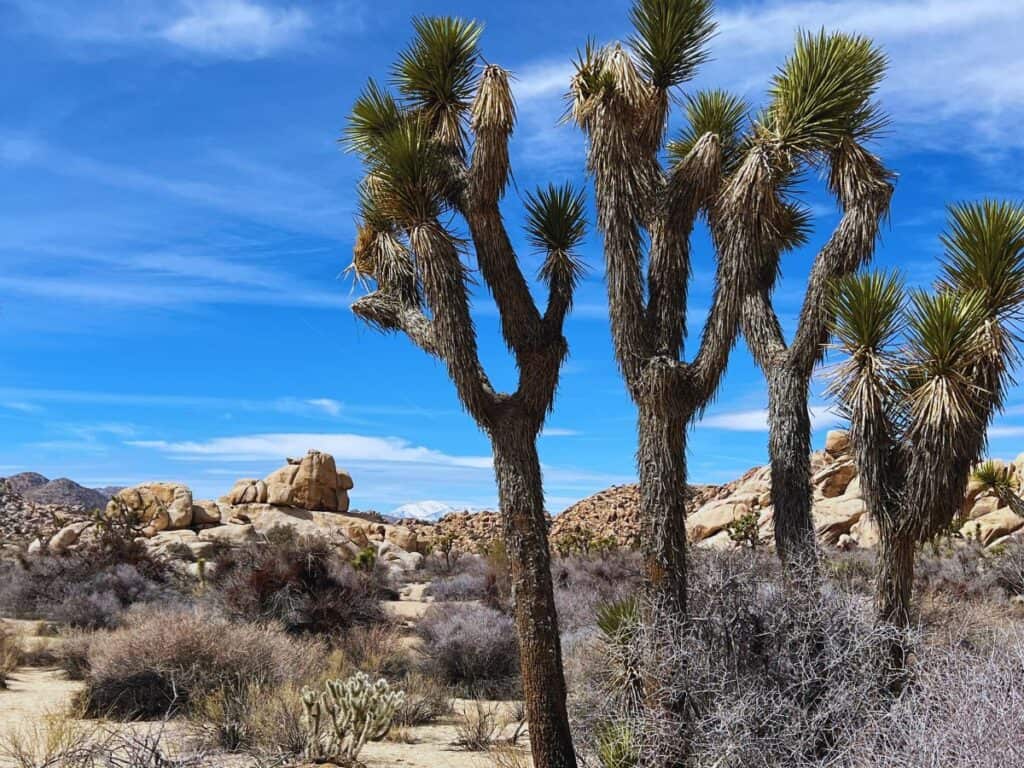
Joshua Tree National Park feels like a desert dreamscape, where quirky plants and sculpted rocks create a world unlike any other.
Why It’s Special
Joshua trees are actually succulents, not trees, and they grow almost exclusively in the Mojave Desert at elevations between 1,500 and 6,000 feet. Their twisted, spiky limbs and surreal silhouettes make them look like something out of a Dr. Seuss story.
Beyond their visual charm, Joshua trees play a vital role in the desert ecosystem, offering food and shelter to mammals, birds, insects, and lizards. To many, their resilience symbolizes that life, love, hope, and beauty can survive even the harshest conditions. Some researchers estimate their average lifespan at 150 years, though others believe they can live much longer.
Best Time to Visit
Spring and fall offer the most comfortable hiking weather, with cooler temperatures and clear skies. Sunrise and sunset are especially magical, casting golden light across the trees and desert landscape. Winter brings crisp air and excellent stargazing, while summer can be dangerously hot.
Our Experience
I’m fascinated by plants that grow exclusively (or nearly exclusively) in specific regions. It makes me appreciate them even more. Joshua Tree National Park, with its strange-looking trees and dramatic rock formations, truly feels like a make-believe world. Hiking trails give you close views of the trees and offer chances to scramble across boulders, which is a lot of fun. I must admit, it’s unusual to visit a park where botany and geology steal the show from zoology.
The unique trees provide spectacular silhouettes at sunrise and sunset, and another desert plant steps into the spotlight during those times. Teddy bear cholla look soft and cuddly, but their barbs will leave a mark. Still, when the light hits them just right, they glow yellow and seem almost magical.
The park is also great for stargazing. Joshua trees remain faintly visible under the starlit sky, reminding you of their quiet majesty. Admittedly, the trees didn’t blow me away like the redwoods did, but these quirky plants put on a worthy show and left a lasting impression.
Learn More and Plan Your Visit
For insights on the park’s trails and top attractions, explore our complete guide to Joshua Tree National Park.
Saguaros – Saguaro National Park

The Sonoran Desert holds a surprise for anyone expecting endless cactus fields. This park is where the giants truly shine.
Why It’s Special
Saguaros are the largest cacti in the United States and a true icon of the American West. Often depicted with two arms and a prickly silhouette, they’re frequently humanized in cartoons, but the real thing is even more captivating.
These giants grow only in the Sonoran Desert and take their time doing it. At ten years old, a saguaro may be just an inch or two tall. It can take 50 to 70 years before one sprouts its first arm, and they typically reach full height, up to 40 or 50 feet, around 150 years.
Their root systems are just as fascinating: a tap root may reach two feet underground, but most roots spread just 4 to 6 inches below the surface. Talk about an exercise in patience.
Best Time to Visit
Late fall through early spring offers cooler temperatures and ideal hiking conditions. Sunset is especially magical, casting dramatic silhouettes across the desert. Winter nights are perfect for stargazing, and spring brings blooming desert wildflowers.
Our Experience
On our trip to Arizona, I expected to see giant cacti everywhere. I was shocked to learn they only grow in a specific region.
I’ll admit, I worried the park might feel monotonous, but the saguaros were anything but. Some had many arms, others none, and a few had twisted shapes that looked straight out of a cartoon. It felt like each one had its own personality. They’re surprisingly fascinating, and anything that survives the harsh desert deserves our respect.
Seeing them at sunset, silhouetted against a blazing sky, was one of my most memorable experiences. As the light faded and stars appeared, desert animals stirred and called out across the landscape. It’s something you have to experience for yourself.
Learn More and Plan Your Visit
Our full guide to Saguaro National Park covers hiking trails, scenic drives, and the remarkable cactus that gives the park its name.
Bristlecone Pines – Great Basin National Park
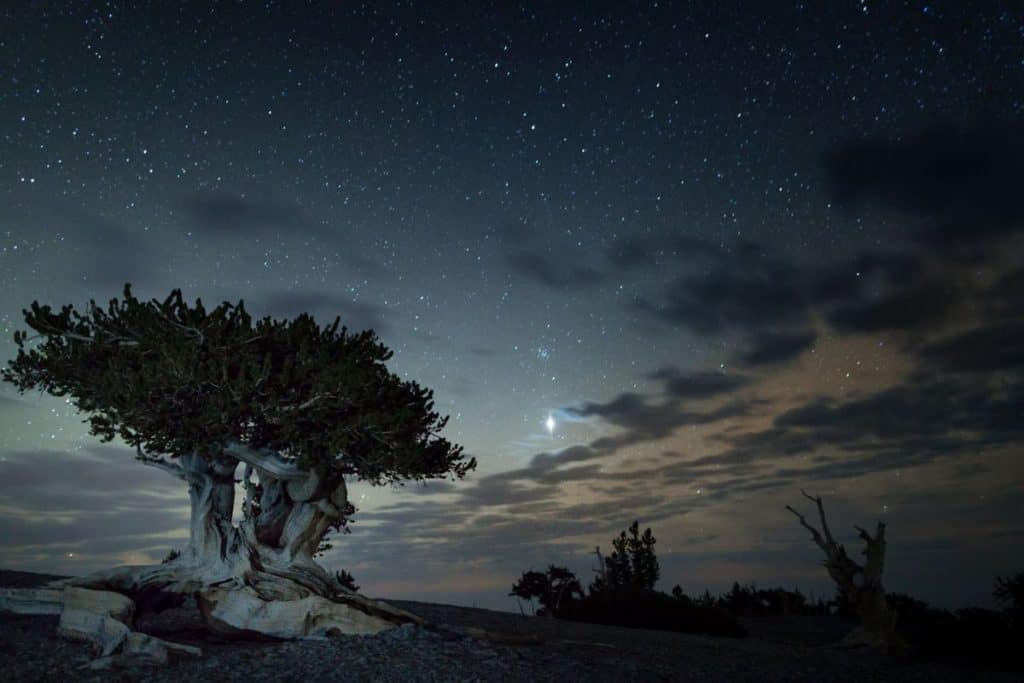
This remote park is still on our list, but everything about it calls to us. Ancient trees, alpine lakes, limestone caves, and some of the darkest skies in the country make it a must-see.
Why It’s Special
Great Basin National Park is home to some of the oldest living trees on Earth. The Great Basin bristlecone pines have stood for thousands of years, with some estimated to be more than 4,500 years old.
These twisted, weathered trees grow just below the tree line in rocky, high-altitude terrain where few other plants survive. Their slow growth makes their wood incredibly dense and resistant to decay, helping them endure through centuries of wind, snow, and drought.
One of their most fascinating traits is something called sectored architecture. Each root feeds only the part of the tree directly above it, so even if one section dies, the rest can keep living. It’s a quiet kind of resilience, shaped by time and terrain.
Best Time to Visit
Late spring through early fall is ideal for hiking to the Wheeler Peak Grove, where many bristlecone pines grow. Summer skies are perfect for stargazing, and fall brings crisp air and solitude.
Our Thoughts
Even though we haven’t made it to the Great Basin yet, this park is right up my alley. I’m drawn to plants that grow in specific regions, and these ancient survivors are found only in parts of Nevada, Utah, and California. Add in the dark sky designation, small crowds, and the chance to explore limestone caves and alpine lakes, and it’s easy to see why this one is high on our list.
Sequoias – Sequoia and Kings Canyon National Parks
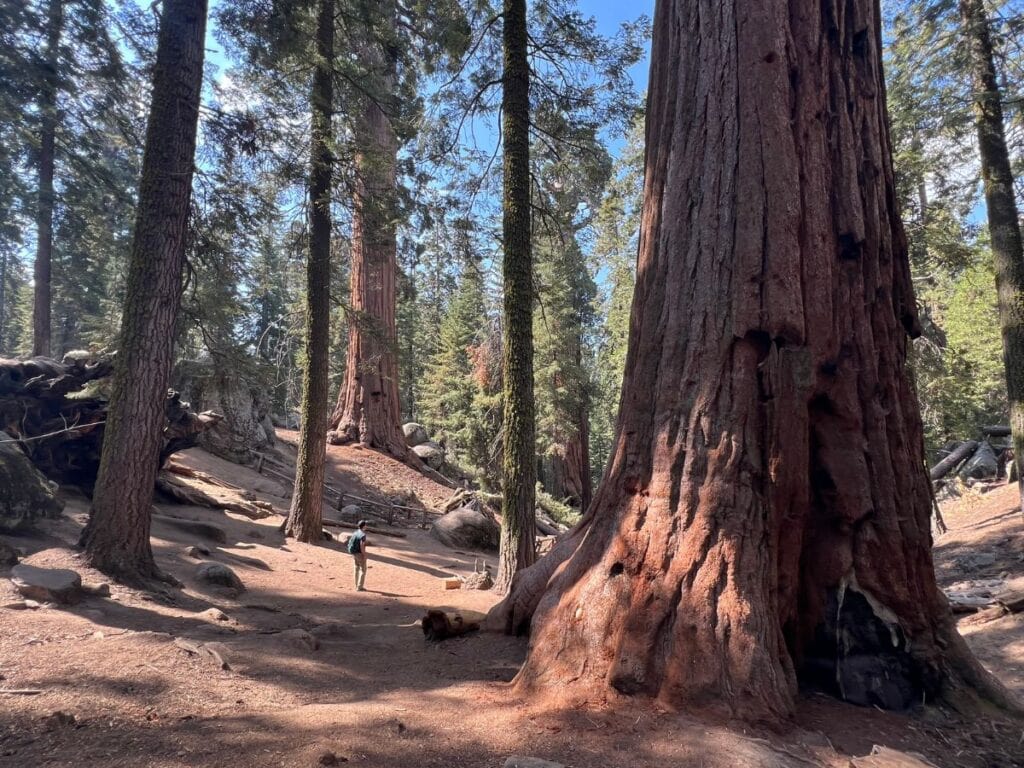
These neighboring parks deliver a one-two punch of towering trees and dramatic Sierra landscapes.
Why It’s Special
Sequoia and Kings Canyon National Parks are home to the largest trees on Earth by volume. The most famous, the General Sherman Tree, stands 275 feet tall and has a base diameter of over 36 feet.
While not quite as tall as coastal redwoods, giant sequoias are far thicker and still tower above most other trees. Their massive trunks and fire-adapted bark make them feel ancient and indestructible.
The parks protect over 30 sequoia groves, including the Giant Forest and Grant Grove, and offer access to granite domes, deep canyons, and alpine wilderness.
Best Time to Visit
Late spring through early fall offers the best access to trails and scenic drives. Summer brings warm days and clear skies, while fall offers golden light and fewer crowds. Winter can be magical too, with snow-dusted sequoias and quiet trails.
Our Experience
We were blown away by the giant sequoias. These parks offer fantastic hiking trails and scenic drives where you get close views of the trees and breathtaking granite domes, similar to Yosemite.
Like the redwoods, looking up will crane your neck. Hugging the trees gives you a sense of their size, but walking and driving through tree tunnels really hits home that these giants are beyond imagination.
Having access to two parks so close together is the icing on the cake. Each offers plenty to explore in its own right.
Learn More and Plan Your Visit
We’ve created separate guides for Sequoia National Park and Kings Canyon National Park, covering trails, scenic drives, and the unforgettable trees that define each park.
Sitka Spruce – Olympic National Park
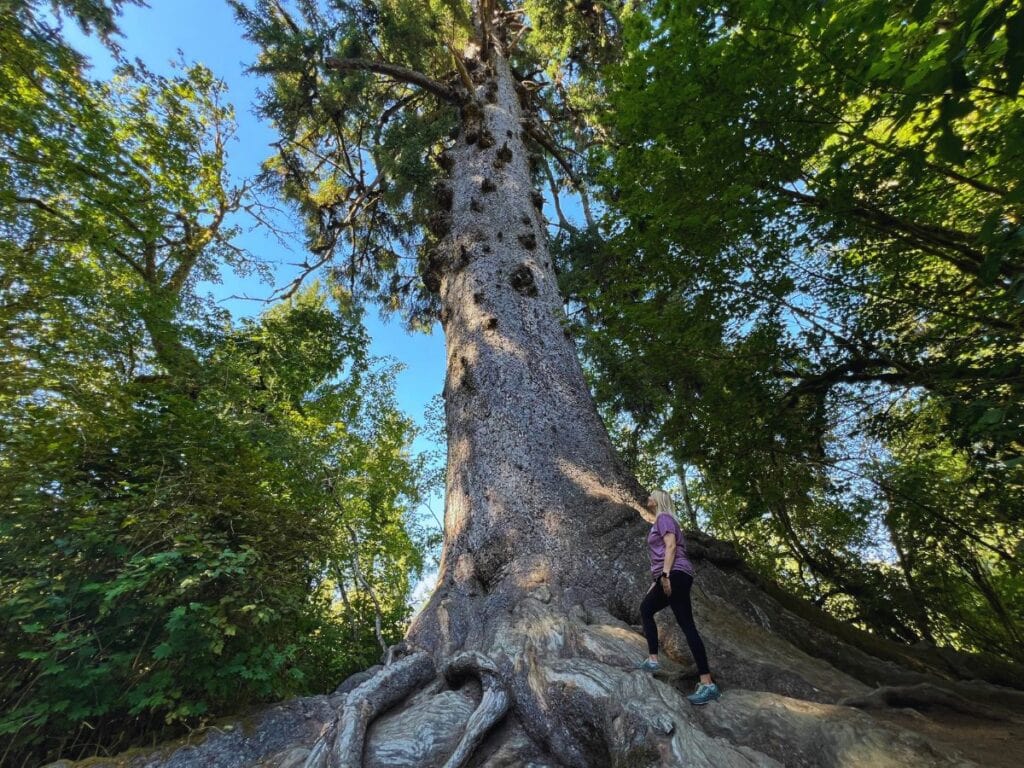
Olympic National Park is a place of contrasts, with rugged beaches, alpine peaks, and lush temperate rainforests. For us, the Sitka spruce were one of the highlights.
Why It’s Special
The Sitka spruce is among the tallest and most massive conifers in North America, thriving in the cool, moist conditions of coastal rainforests. While not as tall as redwoods or as bulky as sequoias, they can still reach heights of over 200 feet and live for hundreds of years. Their bark is thin and scaly, and their needles are stiff and sharp, adapted to withstand salty air and strong coastal winds.
Olympic National Park is home to the world’s largest Sitka spruce, located in the Quinault Rain Forest. This champion tree stands 191 feet tall, with a circumference of nearly 59 feet and an estimated age of 1,000 years. The park also hosts five other champion trees, making the Quinault Valley a true “Valley of the Rain Forest Giants.”
Another standout is the Tree of Life, a Sitka spruce perched precariously over a cave on Kalaloch Beach. Its massive roots cling to the eroding cliffside, allowing it to survive despite losing most of its supporting soil. It has become a symbol of perseverance and resilience.
Best Time to Visit
Spring through fall offers lush greenery and accessible trails. Rain is common year-round, but it adds to the forest’s mystique. Sunrise and sunset bring golden light to the mossy groves, and winter storms often reshape the coastline near Kalaloch.
Our Experience
Julie and I were so excited to see the rainforests, and they exceeded every expectation. Any photo I’ve seen before or since doesn’t capture the magic. These forests genuinely feel enchanted.
Although the trees aren’t as tall or massive as those in Redwood or Sequoia, many are still enormous. Moss drapes from branches, and ferns blanket the forest floor. The setting is breathtaking, and like photographs, I can’t do it justice.
Hiking through these groves was unforgettable. The Tree of Life especially left an impression. It’s hard to believe something so exposed can survive storm after storm.
Learn More and Plan Your Visit
We’re still building out our Olympic National Park guide, but it’s live and growing. If you visit the page, just know it’s a work in progress. We’ll be adding more trail tips, tree highlights, and rainforest insights soon.
Bald Cypress – Congaree National Park
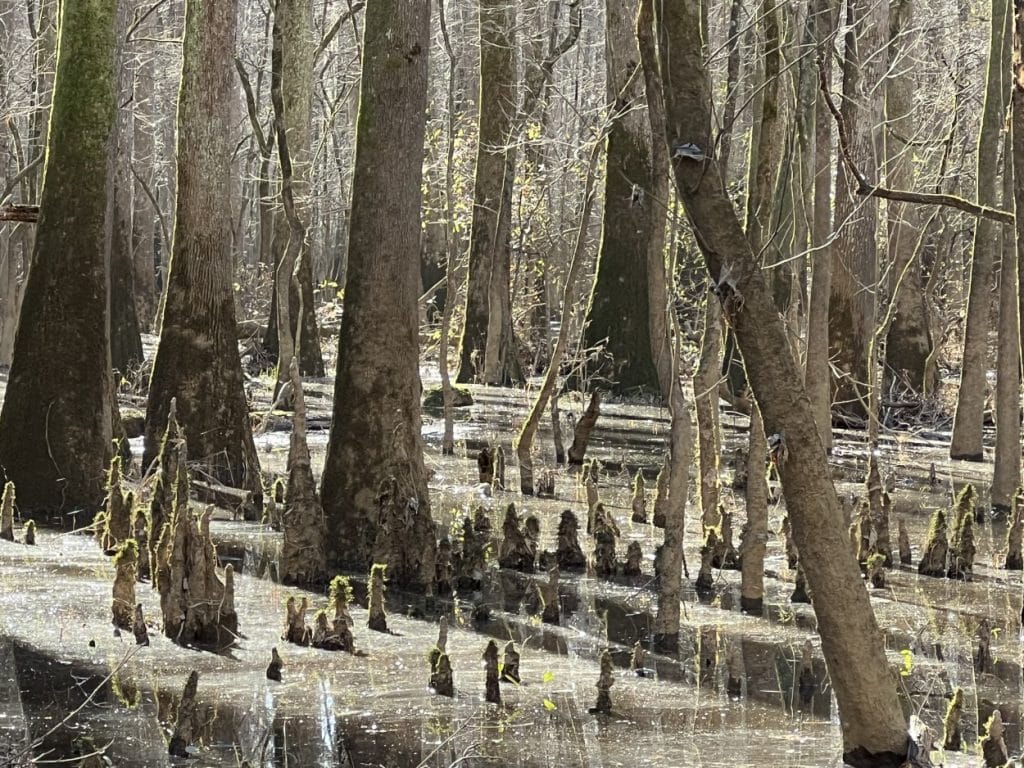
I expected Congaree to feel like any forest near our backyard. I was wrong.
Why It’s Special
Congaree National Park protects the most extensive intact stretch of old-growth floodplain hardwood forest in the southeastern United States. Its average canopy height exceeds 100 feet, and it holds North America’s highest concentration of champion-sized trees, including towering loblolly pines and massive bald cypress. The park floods regularly, bringing nutrient-rich waters from the Congaree and Wateree Rivers that support this lush, biodiverse ecosystem.
The Boardwalk Loop Trail offers close-up views of these giants, winding through a forest that feels both ancient and alive. Bald cypress trees are especially striking, with their knobby “knees” protruding from the water and their rust-colored foliage glowing in fall. These trees are rare hybrids, behaving like conifers but shedding their needles each year. Their presence adds to the park’s surreal beauty.
Best Time to Visit
Fall brings colorful foliage and cooler temperatures. Winter offers quiet trails and dramatic silhouettes. Spring showcases lush greenery, bird activity, and the full floodplain experience.
Our Experience
The boardwalk trails were outstanding. When we visited, water had topped a few small sections, giving us a real feel for the floodplain.
Walking along the forest floor on raised paths was peaceful and immersive. We saw squirrels, birds, and countless trees up close. The park draws fewer visitors than most, which made the experience even more serene.
I’ve always been fascinated by bald cypress trees, and seeing so many in one place was a delight. Their knees, their color, and their distinctive form make them a tree I never tire of. A neighbor has two in their yard, and I look forward to their fall foliage every year. Congaree gave me that same joy, multiplied.
Learn More and Plan Your Visit
Our guide to Congaree National Park covers trail tips, seasonal highlights, and the trees that make this park so special.
Torrey Pines – Channel Islands National Park
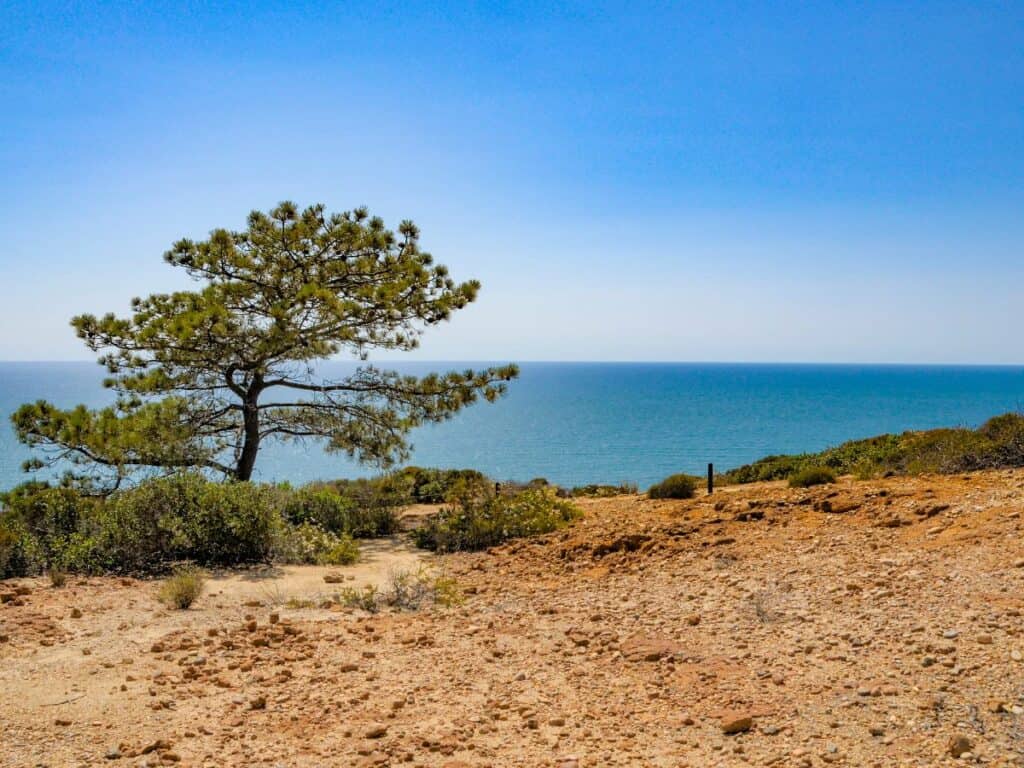
Channel Islands National Park protects rare animals and rare plants, and the Torrey pine is one of its most extraordinary residents.
Why It’s Special
The Torrey pine is the rarest native pine in the United States, and possibly the rarest pine species in the world. It grows naturally in only two places: Santa Rosa Island in Channel Islands National Park and a small stretch of coastline near San Diego. With roughly 3,000 trees remaining, it is considered critically endangered.
What makes the Torrey pine remarkable is its ability to survive in dry, windswept, and nutrient-poor coastal environments. Its needles are long and flexible, helping it capture moisture from fog. The tree’s deep roots anchor it in sandy soil and allow it to withstand strong ocean winds. On Santa Rosa Island, the grove stands out against the otherwise shrub-filled hillsides, offering a rare glimpse of resilience and adaptation.
Best Time to Visit
Spring and fall offer cooler temperatures and clearer skies. Santa Rosa Island requires a ferry ride and a long day trip, but the hike to the Torrey pine grove is a highlight for plant lovers and solitude seekers.
Our Thoughts
While we only explored Santa Cruz Island during our visit, I was thrilled to see the rare island scrub jay and island fox. Knowing that Santa Rosa Island harbors the rare Torrey pine makes me even more eager to return.
I love discovering plants that grow in only one or two places, and this park offers that in spades. The combination of rare flora and fauna makes Channel Islands National Park feel like a hidden world worth exploring in full.
Yucca and Ocotillo – Big Bend National Park
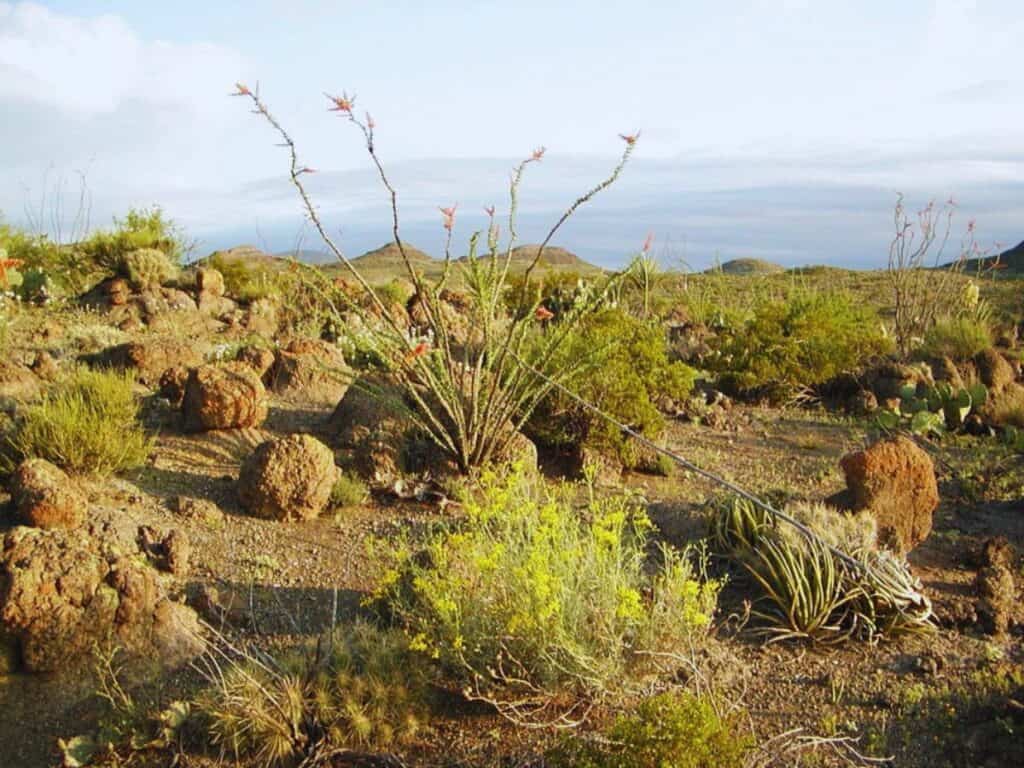
We haven’t visited Big Bend yet, but it’s high on our list. The desert plants alone make it worth the journey.
Why It’s Special
Big Bend National Park is home to a stunning variety of desert flora, with yucca and ocotillo standing out as two of its most iconic species. These plants thrive in the park’s extreme conditions, from rocky slopes to sunbaked flats, and they’ve evolved remarkable adaptations to survive.
Yucca plants, including the striking Big Bend yucca, feature tall stalks with clusters of white flowers and pale blue-green leaves arranged in a symmetrical rosette. Their deep roots help them access scarce water, and their tough leaves resist heat and drought. Some varieties even form tree-like trunks, adding sculptural beauty to the desert landscape.
Ocotillo is one of the most unusual plants in the park. Its spiny, whip-like stems remain bare for much of the year, but after rainfall, they burst into vibrant green leaves and fiery red flowers. This dramatic transformation supports pollinators like carpenter bees and hummingbirds, and its ability to leaf out quickly after rain makes it a master of desert survival.
Together, these plants define the visual character of Big Bend: resilient, dramatic, and full of surprises.
Best Time to Visit
Late winter through spring is ideal for plant lovers. February and March bring desert bluebonnets and early blooms, while April and May showcase yucca flowers and ocotillo in full color. Fall offers cooler temperatures and golden light across the desert. Summer is extremely hot and best avoided for hiking.
Our Thoughts
We’re drawn to parks with rare plants and dramatic landscapes, and Big Bend checks both boxes. The idea of seeing yucca blooms, ocotillo flares, and rugged canyons all in one place is incredibly appealing. I’m especially intrigued by how these plants survive and thrive in such harsh conditions. The solitude, the scale, and the seasonal color make this a must-visit for us.
Wildflowers – Great Smoky Mountains National Park
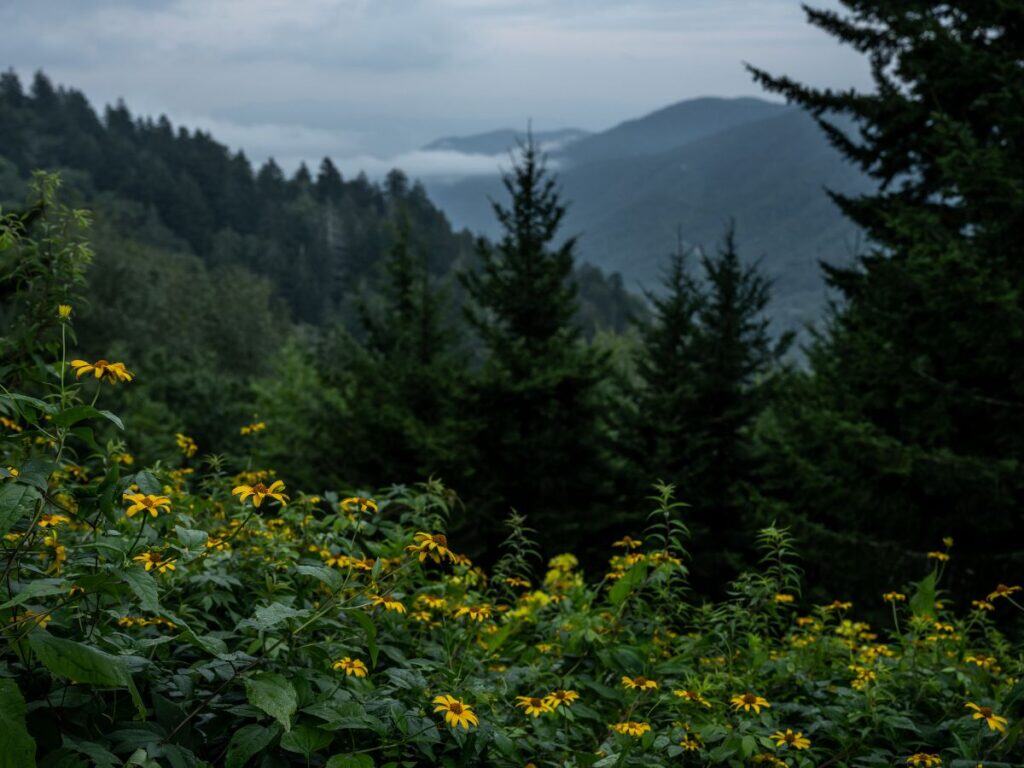
The Smokies are known for black bears, elk, waterfalls, and mountain views, but the wildflowers deserve a spotlight of their own.
Why It’s Special
Great Smoky Mountains National Park is home to more than 1,500 species of flowering plants, making it the most botanically diverse national park in North America. This incredible variety spans all seasons, from spring ephemerals like trillium and bloodroot to late-season asters and goldenrod. The park’s rich biodiversity is supported by its elevation range, moist climate, and ancient geology, creating ideal conditions for wildflowers to thrive.
What makes these blooms truly special:
- Year-round color: Flowers bloom from late winter through fall, giving the park a constantly changing palette.
- Spring ephemerals: These short-lived flowers emerge early, bloom quickly, and vanish before the canopy fills in, an enchanting sign of seasonal transition.
- Pollinator magnet: Wildflowers attract butterflies, bees, and birds, adding movement and sound to the visual beauty.
- Ecological role: Many species support native wildlife and help maintain soil health and forest regeneration.
- Rare and endemic species: Some wildflowers in the park are found nowhere else, making each hike a chance to spot something unique.
Best Time to Visit
Late March through early May is peak season for spring wildflowers. Summer brings rhododendron and mountain laurel, while fall offers golden hues from late-blooming species. Early mornings and shaded trails often reveal the best displays.
Our Experience
We’ve visited the Smokies several times, and the hiking trails never disappoint. Forests, mountains, and waterfalls set the stage, but the wildflowers give the park a fresh coat of paint. Seeing colorful blooms carpeting the ridges is breathtaking.
We love birds, and the flowers seem to draw them in, adding to the experience. While black bears and elk often steal the show, the wildflowers quietly transform the park’s mood and make each visit feel new.
Learn More and Plan Your Visit
Our guide to Great Smoky Mountains National Park covers hiking trails, seasonal highlights, and the wildflowers that make this park so unforgettable.
A Living Tapestry of the Parks
From desert blooms to rainforest giants, these remarkable plants help define the character of each national park. They shape ecosystems, inspire awe, and offer quiet moments of connection. Whether you’re chasing wildflowers, admiring ancient trees, or spotting rare species, the journey is always worth it.
Featured image credit: Miles with McConkey